10x1.5 Disc Magnet, Neodymium
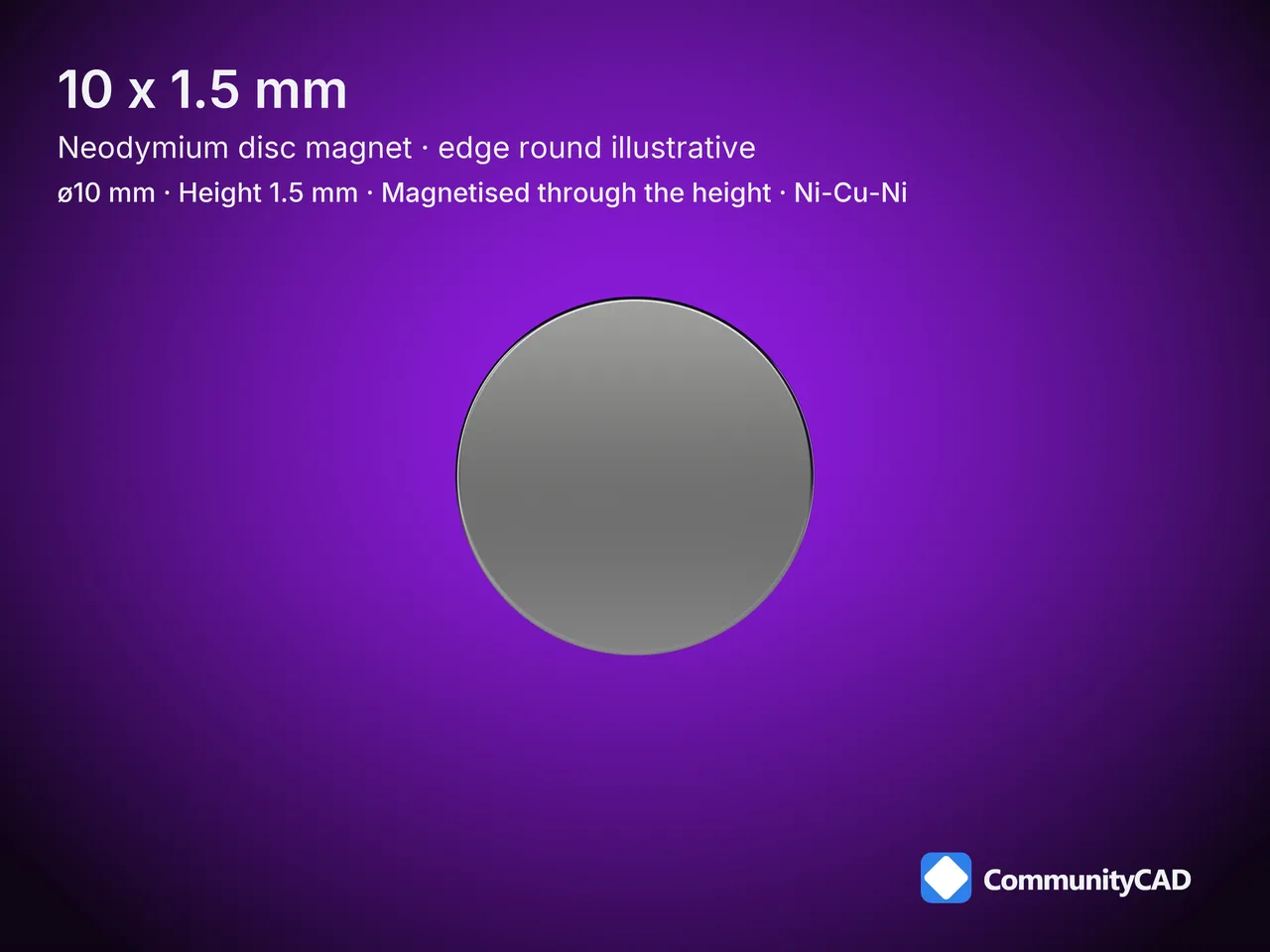
10 mm across and 1.5 mm high, the 10x1.5 disc magnet (Neodymium disc magnet) is nickel-plated and magnetised through the height. Here as simplified STEP files.

How these parts are made, and what the levels mean: read the method
- Also known as: 10x1.5 round magnet, 10x1.5 rare earth magnet, 10x1.5 button magnet, 10x1.5 neodymium magnet
- Model id:
magnets-disc-10x1-5
- Standard: Neodymium disc magnet · size 10x1.5
Files
| Part key | Simplified |
|---|
magnets-disc-10x1-5 | STEP |
Dimensions

| Symbol | Name | min | nom | max | Modeled | Rule | Level |
|---|
| D | Diameter | | 10 | | 10 | nominal | L1 |
| H | Height | | 1.5 | | 1.5 | nominal | L1 |
Drawing

As a PDF: CC-MAGDISC-SZ-10x1.5.pdf.
What each maker states
- supermagnete lists this size in N42, N52, N52N.
- first4magnets lists this size in N35, N42.
- The shape is the same in any grade.
The 10x1.5 disc magnet beside the 10x1 and the 10x2
The 10x1.5 is number 28 of the 51 Neodymium disc magnets published here, listed from 2x1 to 30x10.
- Diameter (D): 10 mm on the 10x1.5 disc magnet, the same on the 10x1 and the 10x2.
- Height (H): 1.5 mm on the 10x1.5 disc magnet, against 1 mm on the 10x1 and 2 mm on the 10x2.
Other sizes
- One size smaller: 10x1 Disc Magnet, Neodymium, 10 mm across, 1 mm high, nickel-plated, axially magnetised.
- One size larger: 10x2 Disc Magnet, Neodymium, 10 mm across, 2 mm high, nickel-plated, axially magnetised.
Conventions
- Simplified only: a magnet has no thread, so there is one detail level. STEP AP214, millimetres, Z the axis of magnetisation, the origin at the centre of one pole face, the other pole face at Z = H; the disc a cylinder of diameter D.
- Nominal sizes; both makers state +/- 0.1 mm, which is metadata and isn't modeled.
- Edge round illustrative, not stated by the makers: every edge rounded at r = the smallest of the part's dimensions / 10, measured for fit.
Documents
Sources
first4magnets-disc, supermagnete-magnets-disc. Full citations: the method page and this size's datasheet.
Found an error? Use the feedback section on this page.


Comments
Sign in to leave a comment.
Loading comments...